Budgeting with variable income: how to pay yourself a fixed salary
“I can’t budget because I don’t know how much I’ll earn this month.” It’s the most common objection from anyone who works for themselves, and it sounds reasonable. If income changes every month, what number do you plan around?
The answer is uncomfortable because it’s so simple: you don’t plan on what you expect to earn, you plan on what you already earned. This article explains the full method —baseline income, fixed salary, stabilization fund— for budgeting with variable income, what to do when a bad month arrives, and how to run it without fighting a spreadsheet.
Can you budget with variable income?
Short answer: yes, but backwards from how you were taught. Instead of splitting up income that doesn’t exist yet, you decide how much to draw each month based on your history, and let the surplus from good months cushion the lean ones.
A traditional budget assumes something you don’t have: a fixed figure landing on the 30th. Without that anchor, any plan collapses at the first odd month. But variable income isn’t random: it has a floor. You almost always earn at least a certain amount, and that floor —not your best month— is the solid ground to build on.
The mental shift is to stop asking “how much will I earn?” and start asking “how much can I draw each month without breaking in the worst case?” That second question does have an answer, and it’s in your own numbers.
Why the traditional budget fails you
Short answer: because classic methods split percentages of a stable monthly income. If yours swings, the same percentage means something different every month and the plan loses meaning.
Take the 50/30/20 method: 50% needs, 30% wants, 20% savings. It works beautifully on a fixed salary. But if one month brings $3,000 and the next $900, the 50% for needs drops from $1,500 to $450 —and your rent didn’t drop. The problem isn’t the method; it’s that it’s missing a prior step when income swings.
That prior step is turning your variable income into a fixed one before splitting it. Once you pay yourself a stable salary, any budgeting method works again, because it finally has the fixed number it was missing.
The method in 4 steps
Short answer: calculate your baseline from the lowest of your last six months, pay yourself a fixed salary below that figure, send the surplus to a stabilization fund, and set aside what was never yours before spending.
Step 1 — Calculate your baseline income
Look at what actually came in over the last six months —not what you billed or hoped for, what landed— and take the lowest month. That’s your conservative baseline.
Most people use the average, and that’s the trap: the average is inflated by the two good months and leaves you short the other four. If your months were $2,800, $1,100, $2,200, $900, $1,900 and $2,400, your average is ~$1,885, but your real baseline is $900. Budgeting on $1,885 means going into the red every time a normal-to-bad month shows up.
Step 2 — Pay yourself a fixed salary
Set a fixed amount you transfer to yourself every month, always on the same day. It must fit inside your baseline, not consume it entirely: aim for 80-90% of that figure to leave some air.
This is the heart of the method. Your business (or your independent work) has variable income; you, as a person, have a fixed salary. It’s the same logic as a company paying steady payroll even though sales rise and fall. From that salary you can finally plan: rent, groceries, savings, all on a number that doesn’t move.
Step 3 — Build your stabilization fund
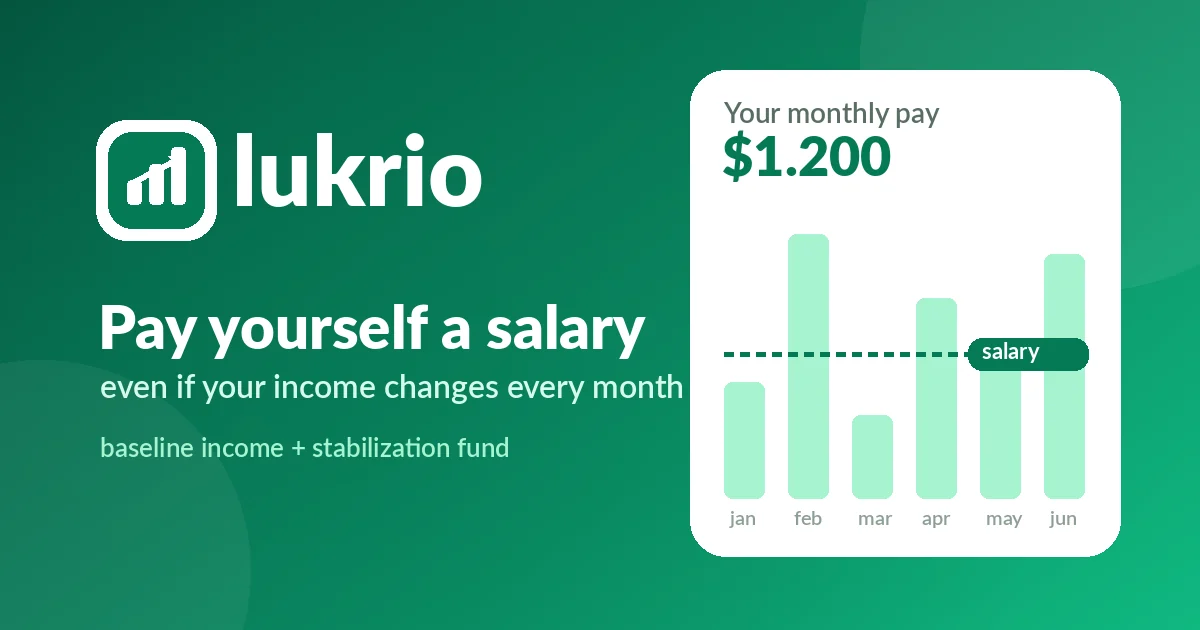
Anything above your salary in a good month isn’t “extra money”: it’s the salary of a bad month that hasn’t arrived yet. That surplus goes into a separate account —the stabilization fund— and from there you top up when a month falls short.
This is what turns the roller coaster into a straight line. Your salary doesn’t change; what changes is where it comes from. A strong month fills the fund, a lean month draws from it.
Step 4 — Set aside what isn’t yours
Out of every payment you receive, part was never yours: the taxes and obligations you have to cover yourself because no employer withholds them. Set them aside the moment the money arrives, not at month’s end.
The practical way is fixed percentages on every payment: one slice to obligations, another to the stabilization fund, and the rest available for your salary. The exact percentage depends on your country and situation, so confirm it with an accountant —but the rule of setting it aside before spending it is universal.
How much cushion you need with variable income
Short answer: at least six months of essential expenses, more than the three to six recommended for someone on a fixed salary, because your income risk is higher.
It’s not an arbitrary number. Around 80% of independent and gig-economy workers couldn’t cover a USD 1,000 surprise without borrowing, and 45% report high levels of economic anxiety. The cushion isn’t a luxury: it’s what separates a lean month from expensive debt.
Mind the distinction: the stabilization fund covers the normal swing in your income ($900 months vs. $2,800 months). The emergency fund covers the exceptional (illness, losing your main client). They’re two different pockets and it’s best not to mix them.
What to do in a bad month (and in a good one)
In a bad month, your salary doesn’t move: you top it up from the stabilization fund and carry on with your normal life. That’s exactly what you built it for. What you do review is whether it was an isolated bad month or the start of a trend —and to know that you need history, not memory.
In a good month, the danger is the opposite: that spending climbs as if this were your new level. The rule is simple: your salary doesn’t go up because you had one good month. First you fill the stabilization fund to its target, then the emergency fund, and only when both are healthy do you consider raising your salary —permanently, and with data to back it.
Make that adjustment every three to six months, not monthly. If your baseline rose consistently, raise your salary. If it dropped, lower it before the fund drains.
How to run it without dying in a spreadsheet
Short answer: the method depends on one thing —knowing what came in and what went out, month by month. Without that record you can’t calculate your baseline or tell whether the fund is holding. And that record is exactly what almost everyone abandons.
This is where most people fail. Not on the concept, but on the operation: you have to log every income and expense for months to build history. A spreadsheet demands you sit down and fill it; an app demands you remember to open it.
That’s why the logging has to live where you already are. With a financial assistant on WhatsApp you send a message —“got paid $900 for the contract,” “paid $320 rent”—, a voice note, or a photo of the receipt, and it’s logged and categorized. Six months later you don’t have to reconstruct anything: you ask how much came in each month and there’s your baseline, from real data instead of memories.
If you work on your own across several streams, the guide on finances for independent workers explains how to separate them so this method works with each source.
Start this week
Don’t wait until you have six months of history to begin. Start today with what you have: review what came in over the last three months, take the lowest, and pay yourself a salary of 80% of that figure this month. It’s an imperfect baseline, and it’s still infinitely better than spending based on whatever lands.
In parallel, log every income from today on. In six months you’ll have the exact figure and can fine-tune the salary precisely. What matters isn’t that the first number is perfect: it’s that you stop living month to month without knowing what you’re standing on.
Having variable income doesn’t mean your life has to be variable. It means the work of stabilizing it falls to you —and that it can be done.
Want a fixed salary even when your income changes?
Lukrio was born so that anyone —no matter how much they know about finance or how irregular their income— can understand their money, plan with peace of mind, and build the future they want.
Lukrio is a personal finance assistant that lives in your WhatsApp, and its name is Daniel: you log every income and expense by text, voice, photo, or PDF, and it shows you how much came in each month, what your real floor was, and how your fund is doing. The history this method needs, without you keeping a single spreadsheet.
If this article helped, see also the 50/30/20 method, finances for independent workers, and how to manage your finances on WhatsApp.
Frequently asked questions
Can you budget with variable income?
Yes. The trick is not to budget on what you expect to earn, but on what you already earned. You take the lowest of your last six months as your baseline income, pay yourself a fixed salary from that figure, and save the surplus from good months to cover the lean ones.
How do I calculate how much to pay myself if my income changes?
Look at what actually came in over the last six months and take the lowest month. That's your conservative baseline. Your monthly salary should fit inside that figure, not inside your best month or your average, which is almost always optimistic.
What do I do in a month when I earn less than my salary?
That's what the stabilization fund is for. In good months you save the surplus above your salary; in lean months you top up from that fund. Your salary doesn't change, only where it comes from. That way you stop cutting your life every time a payment is late.
How much should I have saved if my income is irregular?
The usual recommendation is at least six months of essential expenses, more than the three to six advised for someone on a fixed salary, because your income risk is higher. You don't build it all at once: it grows from the surplus of good months, one month at a time.