7 common personal budget mistakes (and how to avoid them)
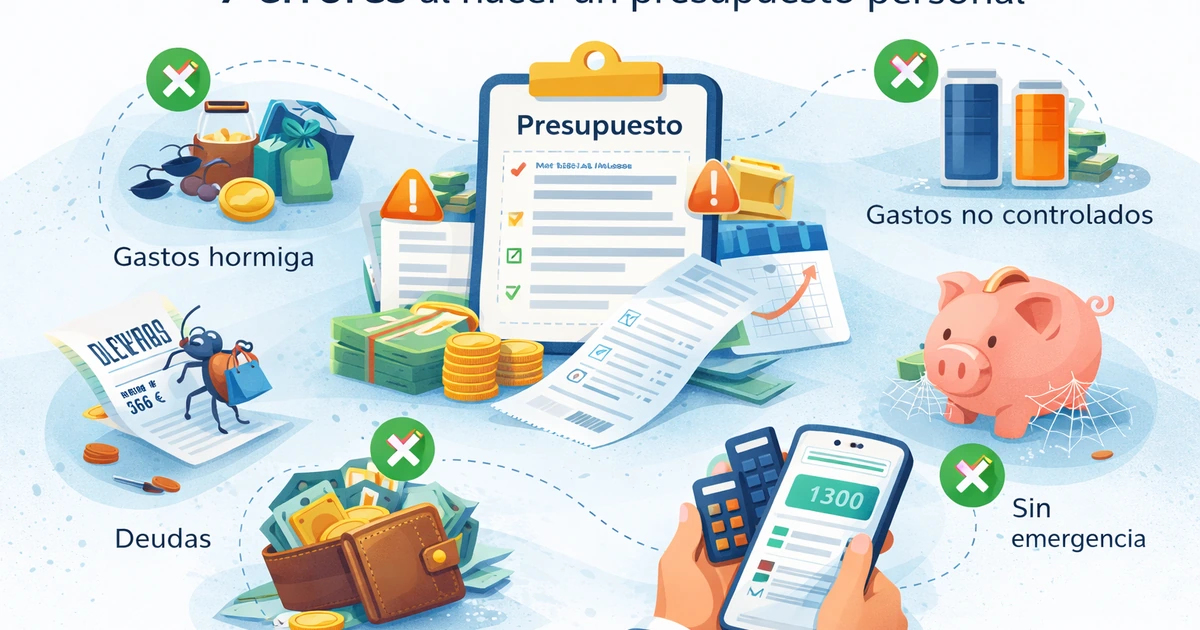
Most budgets fail. And they don’t fail for mysterious reasons or because the person “lacks discipline”. They fail because of budgeting mistakes that repeat themselves over and over, predictably enough to be listed. Spotting them upfront saves you the first three months of trial and error.
This article covers the seven most common mistakes I see in people trying to manage their personal finances for the first time (or the fifth time after several attempts). For each one I give you the real cause, the symptom, and the practical fix. At the end, the golden rule that ties everything together.
Mistake 1 — Budgeting with idealized numbers instead of real ones
This is the most common mistake. The person sits down with a blank sheet, thinks “how much should I spend on food?”, writes $300, and so on for every category. The result is a budget based on wishes, not data.
Symptom: at the end of the first month, almost every category is over budget. Not because of overspending, but because the initial numbers were never realistic.
Fix: don’t build the budget before knowing your real spending. Log first without budgeting for 30-45 days. That log is your baseline. From there you adjust with data, not fantasy.
Mistake 2 — Forgetting annual or quarterly expenses
Monthly you pay rent, utilities, and groceries. But once a year the vehicle tax, school tuition, or insurance renewal shows up. If you don’t prorate them monthly, they ambush you and break the budget.
Symptom: everything goes well for 3-4 months and suddenly a catastrophic month hits where all the savings get consumed by a forgotten payment.
Fix: make a list of all non-monthly expenses (annual, semiannual, quarterly), sum them, divide by 12, and add it as a fixed line in your monthly budget called “Annual expense fund”. When the expense arrives, it comes out of there, not the normal flow.
Mistake 3 — Ignoring small recurring expenses
$4 for a coffee, $3 for a soda, $2 in tips, $6 on a small delivery. Individually they seem like nothing. Added up over a month they can be $200-400. Over a year, the value of a vacation.
Symptom: “I don’t understand where the money goes, I don’t buy anything big”. That means the small recurring expenses are the protagonist.
Fix: for two weeks, log absolutely everything, no exceptions. Any outflow, even $1. At the end, review the total of transactions under $10. The number will impact you. From there, decide whether you keep them consciously or set an explicit cap.
Mistake 4 — Savings goals that depend on “what’s left over”
“I’ll save whatever’s left at the end of the month”. This never works. What’s left over is always zero or less. Spending tends to expand to fill available income (Parkinson’s law applied to money).
Symptom: 6 months pass and the savings account has the same amount as at the start (or less).
Fix: save first, spend after. On payday, immediately transfer the savings target to a separate account. What remains is what you have to spend. This is called “pay yourself first” and it’s the difference between someone who saves and someone who doesn’t.
If your income is irregular (freelance), the rule shifts: each time a payment comes in, you set aside a fixed percentage (e.g. 20%) before anything else.
Mistake 5 — Overly restrictive budgets
The person gets enthusiastic, cuts everything to the minimum: “$100 for entertainment” when historically they spend $400. For 2-3 weeks they hold on. By week four they explode, spend $500 on a weekend, feel guilty, and abandon the system.
Symptom: cycles of extreme austerity followed by binges. The budget typically lasts less than 45 days before collapse.
Fix: gradual, not revolutionary budgets. If you spend $400 on entertainment, don’t drop to $100. Drop to $350, hold for 2 months, then $300, etc. A 20-30% reduction is sustainable; a 75% one isn’t. Your brain doesn’t accept violent changes to spending habits.
Mistake 6 — Not having an “Unexpected” category
Life has flat tires, unscheduled birthday gifts, fines, repairs, friends who ask to borrow. If your budget assumes none of this will happen, the first unexpected breaks everything.
Symptom: you feel like a failure when an unexpected expense derails the budget. Reality is that the budget was poorly designed, not you.
Fix: allocate 5-8% of income to an “Unexpected” category inside the monthly budget. If you don’t use it, it rolls into the month’s savings. If you use it, it absorbs without breaking anything. A budget without an unexpected-expense buffer is fiction.
Mistake 7 — Not reviewing until end of month
The person logs during the month but doesn’t review until day 30. When they review, they’re already $200 over and can’t do anything. The information arrived too late to adjust.
Symptom: every month ends off-target, and the response is “next month I’ll do better”. But without mid-month adjustment, there’s no way it gets better.
Fix: mandatory weekly review. 10 minutes, same day every week. The question is: “am I in line with the budget, over, or under, in each category?”. If you’re over on day 10, you can still slow down. If you find out on day 30, it’s history.
Best review moment: Sunday night, before the next week starts. 10 minutes change everything.
The golden rule
If you remember only one thing from this article, let it be this: the best budget is the one you actually stick to, not the most detailed one.
A three-category budget you use for two years is worth infinitely more than a 30-category budget you abandoned in 45 days. All the technical improvements in the world are irrelevant without continuity. That’s why the mistakes I listed above aren’t about technique; they’re about sustainability. Every mistake, fundamentally, is a way of breaking continuity.
If you’re new to this, start with the simplest thing that works: three categories (50/30/20 rule), weekly review, unexpected fund, save first. With just that, you’re already above 80% of people.
How to avoid all these mistakes with technology
Most of the mistakes above reduce to friction: late review, forgotten logging, fear of opening Excel. The right technology removes friction at every step.
A WhatsApp assistant solves mistakes 3 (small recurring expenses), 7 (late review), and partially 4 (automatic saving): you log in the moment without friction, you receive automatic weekly reports, you can ask “where am I this month?” and know instantly.
In Lukrio this is exactly the design: the bottleneck is always consistent logging and timely review; if those two are automated, the seven mistakes become much easier to avoid. To go deeper, see the complete guide to managing personal finances.
Tired of starting and abandoning budgets?
Lukrio brings the friction to zero. You chat with it on WhatsApp, it tells you every week how you’re doing, and warns you when you’re about to go over in a category. No apps to install, no Excel to open.
To keep going, read how to categorize your expenses, the 50/30/20 rule, and how to run a family budget.