How to categorize your expenses: 12 universal categories
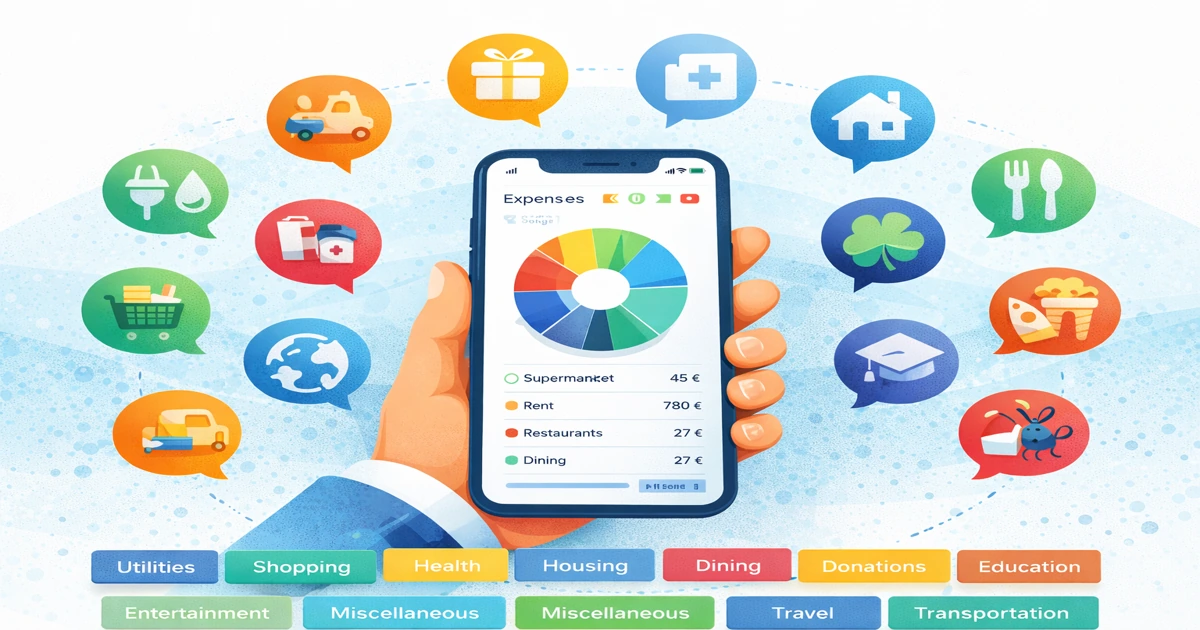
Knowing how to categorize expenses correctly is the difference between a dead list of transactions and a real X-ray of your habits. When every purchase falls into a clear, consistent category, you start seeing patterns: “I spend 28% of my income on dining out and I had no idea”. Without categorization, all expenses look the same, and intelligent decisions become impossible.
But categorizing well isn’t intuitive. Most people make one of two opposite mistakes: either they create too many categories that become unmanageable, or they use three or four so broad that they lose all usefulness. This article gives you the middle ground: 12 universal categories that cover 95% of anyone’s transactions, rules for ambiguous cases, and how to adapt the scheme to your specific situation (freelancer, family, student).
Why categorizing expenses changes your relationship with money
Logging without categorizing gives you flat information. You see you spent $850 in a month, but you don’t know on what. And without that “on what”, you can’t adjust anything with intention.
Categorizing converts data into signals. The useful question stops being “how much did I spend?” and becomes “how much did I spend on each pillar of my life?”. That shift lets you:
- Detect invisible leaks. Forgotten subscriptions, recurring delivery orders, small daily expenses that add up to more than you think.
- Prioritize smart cuts. You know exactly which category to attack without changing your whole lifestyle.
- Budget with real data. Instead of inventing figures, you start from what you already spend and adjust from there.
- See your financial identity. Many people discover their spending doesn’t reflect their stated values, and that’s the starting point for changing something.
The mistake of using too many categories
When someone starts tracking finances, the temptation is to over-detail. Food > Restaurants > Asian Restaurants > Sushi. And so on with everything. It seems like more detail equals more control.
In practice, too many categories create three problems:
- Decision paralysis. Each transaction makes you think “is this ‘casual food’ or ‘social food’?” and that accumulated mental friction leads to abandonment.
- Inconsistency. The same purchase ends up in different categories on different days, making reports useless.
- Signal loss. When each category has $20, none are actionable. The insight dilutes.
The empirical rule: between 8 and 12 main categories is enough for the vast majority of people. If you need pointed detail somewhere, use sub-categories inside a main one, but only the strictly necessary ones.
The 12 universal categories
This is the scheme that works for 95% of people:
- Housing — rent or mortgage payment, building fees, property taxes.
- Utilities — electricity, water, gas, internet, mobile.
- Groceries — supermarket, food to cook at home.
- Transportation — fuel, public transit, taxis/rideshare, vehicle maintenance, parking.
- Health — health insurance, doctor visits, medication, lab tests.
- Education — schools, university, courses, books, materials.
- Personal care — haircuts, toiletries, clothing, gym.
- Entertainment & dining out — restaurants, cinema, events, hobbies, short trips, streaming.
- Savings — emergency fund contributions, goal savings, investments.
- Debt — loan payments, credit cards (minimum and extras).
- Taxes — personal taxes, filings, withholdings.
- Miscellaneous & unexpected — gifts, donations, unexpected expenses that don’t fit elsewhere.
Each person adapts the granularity to their reality. If you have kids, an additional “Kids” category may help. If you have pets, a “Pets” one. But beyond 14-15 total categories, you’re back to the excess problem.
How to classify ambiguous expenses
The hard cases are few but recurring. Some examples:
- Dinner with a client. Entertainment or work? If you’re freelance and the expense is billable, it goes in a separate “Business” category. If not, file it under Entertainment and subtract anything reimbursed.
- Medication bought at the supermarket. Health or Groceries? Health. The point of purchase doesn’t define the category; the nature of the expense does.
- Study books for a personal course. Education — the purpose is formative.
- Food during a leisure trip. Entertainment. The whole trip cost (including food) goes there if the reason for the trip is leisure.
- Food during a work trip. Business or reimbursable.
The golden rule: there’s no universally “correct” classification; there’s consistent classification. Pick a rule and apply it always. The value lies in data consistency, not philosophical precision.
Sub-categories: when yes and when no
Sub-categories are useful when you need detail inside a big category, but only for specific decisions.
Useful example: inside Groceries, separate “Supermarket” (food to cook) from “Eating out” (restaurants, delivery). Two different behaviors with different financial implications.
Useless example: inside Entertainment, separate “Cinema”, “Theater”, “Concerts”. They all respond to the same impulse and are managed together.
Practical rule: add sub-categories only when the decision you’d make with that information is different. If there’s no different decision, the sub-category is noise.
How to adapt the categories to your case
The base scheme is a starting point. Adapt it based on your context:
- Freelancer or independent contractor: add “Business” (supplies, software, advertising) as a separate category. Don’t mix personal with professional.
- Family with kids: dedicated “Kids” category, with sub-categories for school, clothing, extracurriculars.
- Student: smaller in size but same categories. Many combine Education + Books + Materials.
- Older adult with savings: fewer active categories (less variable spending), more focus on Health and Unexpected.
Don’t reinvent the scheme every time. Use it for 3 months as-is, then adjust based on real data, not assumptions.
Automating categorization
The most tedious part of personal finance tracking isn’t logging: it’s classifying. Each expense requires a decision. If you have 50 transactions a month, that’s 50 micro-decisions.
This is where technology can help. Three approaches:
- Apps with manual rules: you configure rules (“any purchase at [supermarket X] goes to Groceries”) and the app auto-categorizes. Requires upfront setup but then runs itself.
- Apps with bank connection: they read your transactions and guess the category. Easy, but introduces privacy decisions around giving access to your accounts.
- AI assistant that interprets context: you send “lunch with Camila $35” on WhatsApp and it classifies as Entertainment. You send the supermarket receipt photo and it classifies as Groceries. It adapts to your natural language.
The last approach is the one we use in Lukrio: you log by talking normally on WhatsApp or by sending a photo of the receipt, and the AI classifies based on context. If it gets it wrong, you tell it “that was work, not entertainment” and it learns. To go deeper, see how to log receipts without Excel.
What to do with categorized information
After 30 days with consistent categories, pull the report. You’ll likely see things that surprise you: the category you thought was small is huge, the one you thought was big is manageable.
That’s the starting point for building a budget based on real data. If you want a simple method, see the 50/30/20 budget rule — it uses the 12 categories as a base, but grouped into three blocks.
Tired of categorizing manually?
Lukrio reads your expenses on WhatsApp and classifies them automatically into the right category. When it gets it wrong, you correct it with a message and it learns. Zero Excel, zero manual rules.
To go deeper, read the complete guide to managing personal finances or how to run a family budget with these categories.